
Making Invisible Visible – Student Study Habits

One of the biggest challenges in teaching – particularly in terms of the more independent levels of work required at A Level – is supporting students to do work for themselves. This is a bigger challenge than working in lessons, or doing a homework task, because I have far less control over the outcome and the process.

And yet, this kind of independent work – reviewing notes, or consolidating knowledge and understanding, and ‘reading around the subject’ – these are all vitally important skills for a great student to have. I think that my biggest challenge is making this work ethos and approach visible and transparent, without writing off huge amounts of my lesson time.

Student Behaviours – a description

I tend to have students whose approach to work falls in to one of four categories:

  • Students who will only do exactly what I tell them, and even then, not always that. For these students, turning up to lessons, and being present in school – and paying attention – is enough. They often are more interested in something else: maybe it’s a new hobby, a new boy/girl friend, or their part time job and social life. The idea of working is “lame” and they don’t really want to do it – other things just matter more. They are explicit and unashamed of this – they have “grown up” and want to be treated as adults.
  • Students who are “spinning their wheels”. They are doing what they are told. They are also doing a lot of other things to “work hard”. Often, it’s ‘make work activities’ which look like strategies they have been taught, or seen other students use – but they are not quite utilising effectively. The best example of this is the student who spends all their time ‘making flash cards’ – but once made, doesn’t know what to do with them, other than to flick through them aimlessly. Whenever there’s a discussion about results, it is almost a despairing cry of “but I’m working really hard”.
  • Students who are working hard, and are honest and clear about what they are doing. Often, this comes with social penalties for the student – they might have to tough out a “geek” or similar label, if they are in an environment where effective and extensive work is not the cultural norm. They have learned some techniques, refined them, and don’t mind getting coaching or advice. They are working very hard, and are prepared to accept short term pain for longer-term gain. Sometimes, these students exhibit anxious tendencies – they have always worked hard, and when the challenge steps up, they respond by trying to do the same. This doesn’t always end well. I have a lot of sympathy: I think this is probably the best description of my own approach to academic work when I was a student, let alone my teaching!
  • Students who make it look effortless. In perhaps one or two cases in my whole teaching career, this has been the result of a genuinely super-talented student. In the vast majority of other cases, it’s not that at all – they are group three students, but they just don’t tell anyone. They do weird behaviours – will chat and socialize until 9-10 pm so it looks like they are chilled and relaxed, but then will work late in to the night without telling anyone. These students are usually socially mixed, quite popular and confident – but for some reason, they feel like they can’t be honest about how much work they are putting in.

There are challenges with each student type – ranging from actually getting work and results, to mental health and wider health concerns.

Student behaviours – what am I trying to change?

For my Group 1s, I’m worried about whether they are going to have the knowledge and understanding from only superficial engagement. I have control over this – whether it’s structuring knowledge, or forcing them to work through punitive/sanction systems – but what I want is them to shift up in to a different category. To do this, I need them to understand how hard “everyone” is working, and to make them feel that not doing work isn’t acceptable or okay. Here, I face the problem of peer group comparison!

For my Group 2s, I’m worried about massive effort/achievement disparities and huge disappointment: they need a longer and cultural shift through cognitive science, learning skills. In theory, an excellent study skills programme – or PSHE – could shift this on, but I’ve never seen one work as well as it could.

However, the struggle is that I need to ensure that the behaviours are not just happening, but visibly happening. My Group 2 students are normally copying the actions of a Group 3 students – “if that person is working like that and getting those results, then obviously if I make flash cards, then I’ll be great too”, without understanding what happens with the flash cards, or how the learning and understanding is embedded. Like Mark Enser’s (@EnserMark) great analysis of the “Rituals of Teaching” (Link), which leads to a culture of doing (Link), students often understand the rituals of learning – we make lists, we make pretty posters, we make many flashcards – All hail the flashcards! – and then… poof! Results happen! – without really knowing how and why they are doing it.

… we make lists, we make pretty posters, we make many flash cards – All hail the flashcards! – and then … poof! Results happen!

I love the work of the Learning Scientists in this regard (@AceThatTest), but I think their analysis is woefully under-applied to many schools – perhaps there’s room for it in a nationally mandated framework, somewhere, to ensure that understanding learning is a key part of how students are taught and prepared?!

My Group 4 students present a different challenge. By making their work invisible, they tacitly give permission to the Group 1 and 2 students to do less. They don’t talk about how much graft, repetition and hard work is going in – so the other students “have permission” not to do it, either. They can also make the Group 3 students worry – how can I keep up with someone? They’re so talented, and not working – I have to work harder!

Student Behaviours – the real world impacts

What fascinates me, though, is the role that the mixture of these students can play in contributing to the overall outcomes of success in a class. The dominant culture can shift behaviours of other students, and it can make a significant difference. In my most recent A Level cohort, I had a real split between my two classes – one dominated by group 3 and group 4 students, and the other with a mixture of 1, 2 and 3. It does not take a huge leap of imagination to guess which of the classes performed better overall. Students, too, are narrow focused. They will look around *their* class, and identify and seek out behaviours and patterns. It’s a rare student who can conceive of the idea that there are hundreds or thousands of students studying the same exam, and they need to be working as hard as the top ten per cent of *them*, not just of their class.

My challenge, then, is not just to recognise this – but to actively influence and do something about it. My biggest hurdle is that I can’t model excellent study habits for them, and I can’t normalize that. For it to be socially acceptable, it must be driven by their peers – otherwise they are just still responding to the extrinsic motivation of my actions.

As ever, I don’t have the answers. I think a whole school culture is critical – teaching all students to have high aspirations, to work hard, to understand how to learn well; but I don’t have the tools to do that easily and effectively.

So, I’d love to hear from people who have got reading, ideas or had success in making this visible, effective, and clear!
Reflections on Middle Leadership – Structures & Reporting

In all of the schools I have worked, the arrangement for line management and accountability has been the same – each HoD works with a line manager from SLT, and has regular meetings through the academic year. At this time of year, there’s a produced exam analysis and report, which feeds in to a meeting and review process.

Prompted by a discussion in messages, I wondered how common this was across other people.

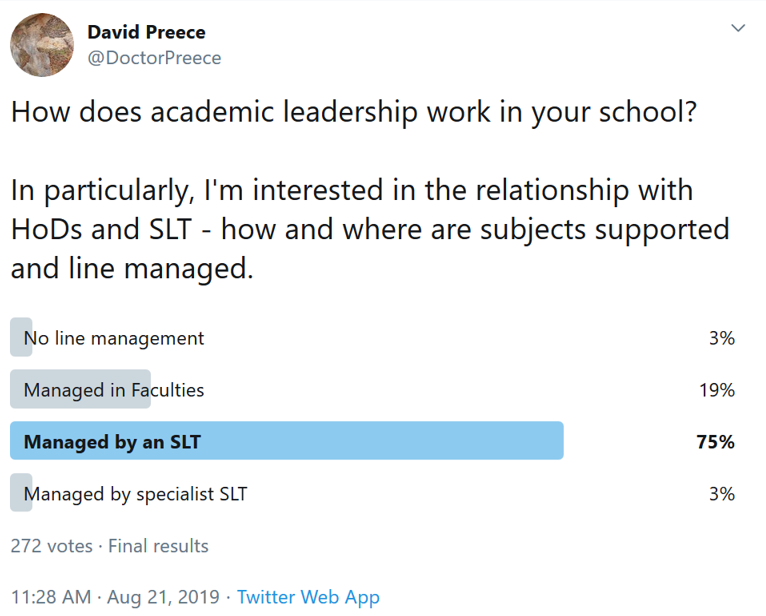
75% of respondents had the same arrangement as I was used to: a non-specialist SLT managing them. 19% of people had Faculty line managers, while 3% were managed by a specialist member of SLT. All of this was fairly straightforward; there are a range of different management structures based on the size of your SLT and school.

I was shocked to see that 3% had no line management – I wonder if this is just exceptionally small schools, or how this is accounted for!

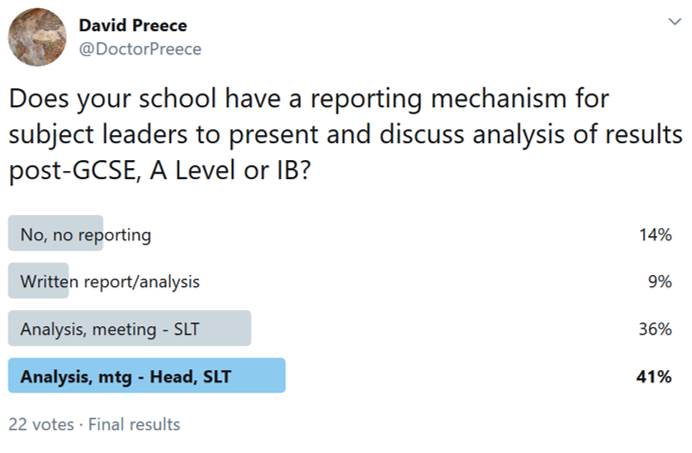
With a much smaller sample size, the overwhelming majority of people have some kind of meeting to discuss their results as a regular process – either with the Head, or their SLT line manager. Again, surprising that 9% only produce a written report – with no opportunity to chat – and 14% have no reporting at all.

What do we learn? Well, I guess that there is a convergence of management and accountability in most schools, and they do it in similar ways. However, what are the implications for i) professional development, and ii) styles of leadership?

  • Being line managed by a non-specialist member of SLT often takes care of the ‘chain of command’ confusion – if you are the HoD, but you have SLT in your Department, who makes the decisions? Far easier to take the line management out of this mix up – thereby creating a ‘non-specialist’ SLT management structure. In some cases, it’s inevitable – if your Head is a specialist in your subject, for example – but it works for most people.
  • Can you realistically have a mentoring relationship with a non-specialist? Some of your subject specific issues (for example, managing portfolios in Art, or DT; managing field trips and controlled assessment for Geography; managing labs and practicals in Science) are really specific skill sets. Does having a non-specialist mean that your line management is different? More difficult? Can they ever give you practical mentoring and advice, or will you only ever have a coaching relationship?
  • Is academic management the same as pastoral management? There are plenty of people who have gone up the ‘pastoral ladder’ – Head of Year, Head of Key Stage, Assistant Head/Deputy Head (Pastoral) – and never line managed a Department. Does this matter? I think many of us would flinch a little at the idea of Heads of Year reporting to someone who’d never been a pastoral leader, as an example, but I have experienced line management by a non-HoD route leader who was outstanding. Again, there’s a conversation about mentoring versus coaching – can you offer advice on something you’ve never had to deal with?
  • One of the cognitive blind spots we generally have is that other people’s successful pathways should be like our own. We are, for instance, a graduate profession. We tend to advocate university education – it’s worked for us. Does this play a role in the management and leadership in schools: what practical route ways can we offer, if we haven’t experienced them? Many options – e.g. subject associations, writing for journals, examining – are things that you know if you’ve grown up in that subject & discipline, but wouldn’t have the same access to from outside.
  • These structures can work well with established and professional relationships – existing HoD and existing SLT. However, the development of that relationship  – and the priority given to it – is critical. New HoDs and new SLT are a significant challenge; worse still when both parties in the line management are new! How can this be sustainable? Should line managers rotate? Stay the same? Pair according to what?

It’s clear that there is a convergence in structures – but to me, they appear to be designed for accountability first and foremost. It is about line management – what have you done, where are you, show me the evidence.

What would these relationships look like if we designed schools for leadership? Or for professional development? How would they change? What would you do if you had a blank slate to start with?

What we’re trying to do: Explicit Vocabulary Teaching

In the previous academic year, we’ve trialled the use of Knowledge Organisers as a way of enriching the content-focus of our teaching. Having these documents and sharing them with students has worked to an extent – and I’ve discussed some of that in a previous post – but the key challenge has really been that they haven’t been utilized to their maximum.

This year, we’d like to try and do something about that, and hit a few objectives.

  • We want to ensure that knowledge is taught explicitly, and referred to explicitly in lessons. This is something we have to do as teachers, but one of our key areas is in the explicit and focused teaching of vocabulary. Without having lessons where we just “teach the words”, it’s critical that we do actually get students thinking and speaking like Geographers.
  • We want to be able to set and work within meaningful and powerful homework exercises. Sometimes, what we do in class is worth discussion and extension – but often, there are ‘gaps’ where a more useful exercise would be to explicitly consolidate knowledge of key terms and vocab.
  • We want to encourage interleaving and regular study habits in students – not leaving everything until the revision time. This helps with their learning, as well as getting them to reflect and utilize the Knowledge Organisers more effectively.

What we’re thinking of doing:

The KO’s allow us to define the vocab that we want to teach over the course of a topic/unit. We have only created KO for the KS3 classes – believing that the specifications/learner guides provided by the exam boards should be able to define the content of the course at KS4 and KS5.

For our KS5, this has undoubtedly been true. Our exam board specification is clear and well written, but they also provide a “Learner Guide”, which has explicit signposts to key terms, vocabulary and approach, as well as key skills and specific details about what you should know about case studies. For our KS4, this is not the case. Although the specification is good enough for experienced teachers, our understanding of it is evolving, and the granularity of the detail does not match our A Level board’s Learner Guide. The first job, therefore, is to write a Learner Guide for KS4, specifying the detail.

The second strand of work is to ensure that all of the knowledge and work is translated in to an easily revisable format. For us, after consultation with EAL, SEN and MFL colleagues, this has been to focus on Quizlet. This is free and accessible to all students who can find our account, and we have the option of letting them join classrooms where we can track their progress and processes.

Our vocabulary or key content is translated in to Quizlet sets. It is possible for students to make their own, but this offers a bit of quality control for us. The creation process is quite simple, and if you’ve got the knowledge defined elsewhere – as we do – then conversion from e.g. a Word document is a matter of moments.

At the moment, our Quizlet sets exist as a whole unit. For some, this isn’t a problem, but for others, this means a very extensive list of vocab which can be significantly off putting for students. Our intention is to break them up in to teachable segments, and this will reduce the “fear factor” of a 150 word vocab list!

Our plan is to set learning and revision as a homework exercise – tracking log in and progress using the Quizlet classroom, to make sure students have done something at home – before producing interleaving quizzes (low stakes, no tracking) to test and use that knowledge in lessons.

I’m excited to see what we can develop with this approach, but would love to get thoughts and feedback – what do you think?